
What if your customer support could answer every question instantly, guide visitors to the right pages, and turn conversations into real opportunities?
An AI assistant makes this possible by using your own content to deliver clear, relevant answers in seconds.
Answer every visitor’s questions, even when search fails
Traditional WordPress search only works well when visitors use the exact right keywords.
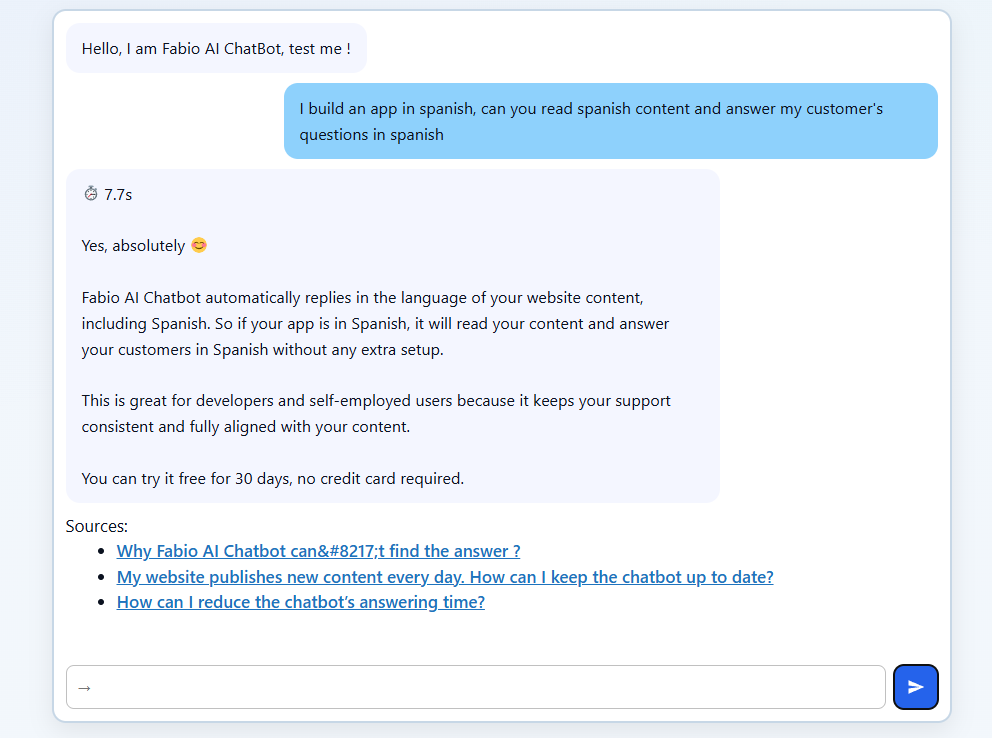
Let’s take the example of Carlos, a Spanish app developer. He has created an app for the Spanish-speaking market and needs a solution that can read his documentation in Spanish and reply in Spanish.
Carlos lands on Fabio AI Chatbot and wants to know whether it works on a Spanish website.
If Carlos uses the classic WordPress search and types a single word like “Spanish”, the search will only return pages containing that exact word.
But if your site only says something like “multi-language supported”, the search may return nothing at all.
And if “Spanish” appears in an unrelated article, WordPress may return the wrong page, which does not help Carlos.
In that situation, Carlos will likely leave the site without finding his answer.
And the same issue applies to many other languages: Portuguese, Polish, Finnish, French, and more.
Now compare that with an AI assistant for customer support like Fabio AI Chatbot.
Even a short sentence such as “this plugin supports any language and answers in the same language as your content” can be enough.
- The AI assistant understands the visitor’s intent
- It gives a direct answer
- It points the visitor to the relevant page
This is one of the primary benefits of deploying an AI assistant for customer support: it can answer questions even when the information is not written in the exact words users type.
Help visitors book appointments
An AI assistant can do more than answer questions. It can also turn conversations into action.
Let’s say your business requires meeting clients, either through video calls or in person.
An AI chatbot can handle support questions and naturally offer to book an appointment at the right time.
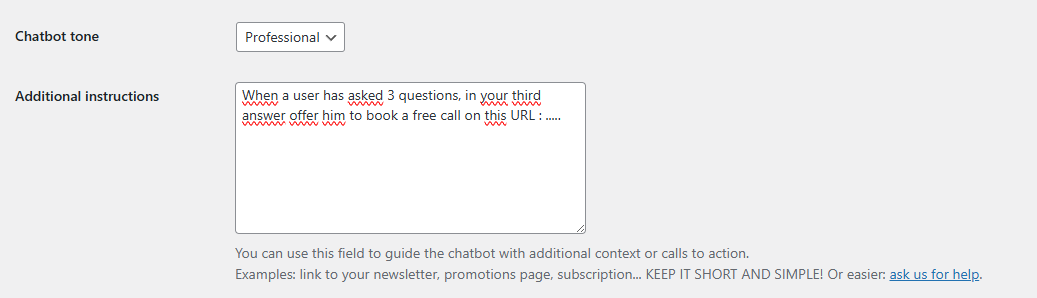
With Fabio AI Chatbot, you simply add instructions and your calendar URL in the “additional instructions” field.
- When the chatbot should suggest an appointment
- How the offer should be phrased
The chatbot then guides the visitor and proposes a meeting when it makes sense.
You provide the calendar link and define the strategy. The AI assistant takes care of the rest.
Filter and qualify leads automatically
One of the strongest use cases is lead qualification.
Imagine your business is credit consolidation. You are willing to offer a free 15-minute consultation, but only to qualified prospects.
For example, you may want to filter by:
- Minimum income required
- Maximum debt ratio
- Employment status
You can configure this directly in the chatbot.
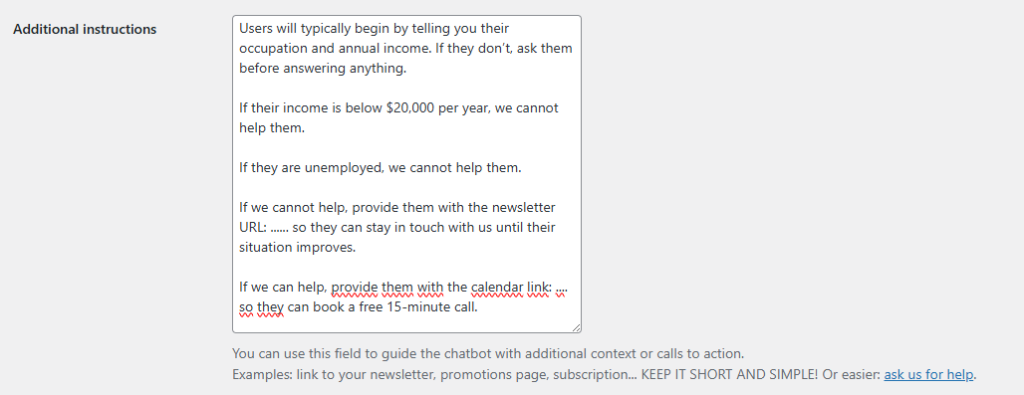
Start with a welcome message such as: “Let’s see how we can reduce your loan payments. What is your occupation and income?”
Then define your filters in the additional instructions:
- If income is below $20,000 → cannot help
- If unemployed → cannot help
- If qualified → proceed to booking
The chatbot will automatically filter prospects and guide them accordingly.
In other words, the AI assistant becomes both your first line of customer support and your first qualification filter.
- A yoga instructor who only wants beginners
- A car dealer who only buys vehicles under specific conditions
- Any service that requires pre-qualification

Provide synthesized answers to complex questions
An AI assistant can combine scattered information and return a clear, summarized answer.
Imagine a website selling multifunction kitchen robots.
A visitor may ask: “I want a robot where I can add ingredients in the morning and schedule cooking so the meal is ready at 7 PM.”
A standard search will only return pages with similar keywords.
An AI assistant, however, can:
- Scan all product descriptions
- Identify models with scheduling features
- Create a useful summary
- Provide relevant links
The same logic applies to a request like: “I’m looking for a robot that saves energy.”
If energy consumption is mentioned across several product pages, the chatbot can compare and summarize the most efficient options.
On a movie streaming website, visitors could ask:
- “Show me comedy movies without violence”
- “I want an action movie that’s easy to watch”
- “Find an adventure movie on a tropical island for kids aged 8 and 10”
The AI assistant understands the request, analyzes the content, and delivers a tailored answer instead of a simple keyword match.
Guide users to the right support content instantly
Another major benefit is helping users reach the exact support resource they need, immediately.
Let’s say you sell professional electronic measuring devices. These tools are complex and often require technical guidance.
Users may ask questions such as:
- “Why do I see this indicator on model X? What does it mean?”
- “What settings should I use on this model to do this or that?”
Instead of forcing users to search through long documentation pages, the AI assistant can:
- Find the answer in your content
- Summarize it in 2–3 sentences
- Provide direct links to the relevant pages
The result is simple: users get an immediate answer and are guided to the correct resource without friction.
This content has been generated by a human, then translated and re-arranged by Artificial Intelligence.